
TV Needs Young Creators to Stay Relevant
A couple of weeks ago I wrote about media redundancies and how brutal the landscape is, especially in radio, where legacy formats are still struggling to adapt to digital even as ad dollars tick up. Now I can’t stop thinking about TV.
Why aren’t we seeing young talent who’ve already proven themselves on digital platforms, with hundreds of thousands or millions of followers, daily content discipline, and clear audience pull, given a serious shot on Australian television? This is the question I want to dig into.
Who Is On Australian TV Right Now (By Age)?
I looked across breakfast shows, panel lifestyle, current affairs, game/variety and reality TV to get a feel for who’s actually fronting Australian TV, and how old they are. The graph below gives you an idea. The median age for television presenters in Australia is about 43. That means the typical on‑air face is in their late‑30s to mid‑40s, and many of the biggest names sit well above that.
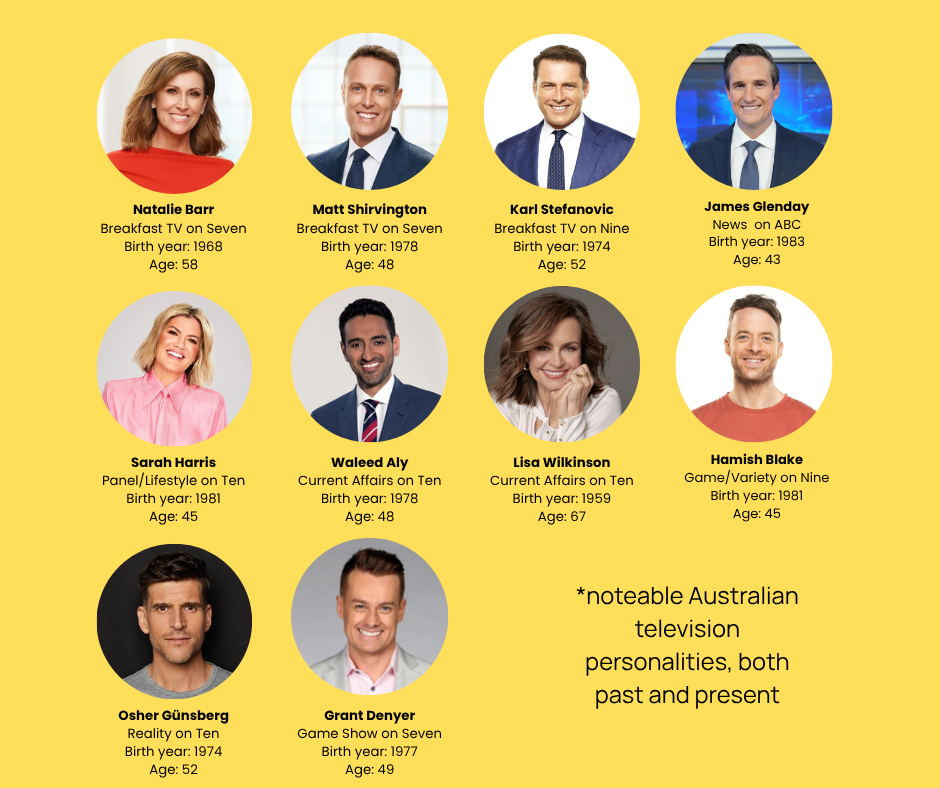
There’s a gendered layer as well. In wider society, older women often become invisible; on TV, older men are allowed to age into “trusted elder statesmen”, while older women have historically been replaced by younger faces far sooner. Australian breakfast and news benches still lean heavily male in the oldest slots, with women more likely to be cycled in and out of high‑visibility roles.
Age as shorthand for “trust” and “authority”
Commercial news and breakfast promos lean hard on “experience” and “trust.” In that visual language, age itself is coded as reliability and deep knowledge: wrinkles, grey hair and long tenure are treated as proof that this person is serious and safe. A 25‑year‑old, even if they’re highly capable, is fighting a baked‑in assumption that youth equals frivolity.
Networks have spent decades teaching viewers that “trusted” equals “seen for a long time.” That narrative doesn’t just shape perception; it shapes commissioning decisions. When they’re nervous about ratings, they retreat to older faces because those faces literally look like what they’ve been selling as trustworthy for years.
Older viewers, older hosts
There’s also the cold math of audience. Older viewers still dominate linear TV consumption and ad impressions; commentary points out that older audiences have “always been catered to… because it’s more lucrative to do so.”
If your revenue still depends on free‑to‑air ad slots watched mostly by over‑40s, casting anchors who look and feel like that demographic becomes a conservative but rational choice. Younger audiences have shifted heavily to streaming and social; the perceived risk of alienating older viewers by refreshing the bench feels larger than the upside of chasing youth with younger talent.
The problem is that if we keep doubling down on this logic, TV’s cultural impact will continue to shrink. Audience attention is fragmenting, youth trust lives elsewhere, and we’re already seeing that traditional linear formats don’t move the needle the way they used to. Once you understand why networks default to older talent, the interesting question becomes: what happens if digital‑first younger creators are allowed into the ecosystem?
How the US and UK Are Using Digital‑First Talent on TV
Us Australians love looking to the US and UK for media playbooks, but on the question of younger talent we’re ignoring their most interesting experiments. Both markets have stopped treating creators as gimmicks and started building pipelines and formats specifically around them.
Primetime reality and entertainment built around creators
In the US, Dancing With the Stars has leaned into creator casting: TikTok and Instagram star Alix Earle, who built her brand on GRWM and lifestyle content, and creator Whitney Leavitt have both appeared as celebrity contestants, alongside our iconic king Robert Irwin. Seasons that embraced creator‑heavy casts saw increases in social interactions and voting, tying digital‑first talent directly to measurable engagement and ratings resilience.
In the UK, creators are embedded even more explicitly. YouTuber and TikTok creator George “Clarkey” Clarke joined Strictly Come Dancing, and his casting announcement became the most‑viewed of the entire lineup on Strictly’s Instagram. KSI, the YouTube star and Sidemen member, has appeared as a guest judge on Britain’s Got Talent, bringing an online audience that often rivals the show’s TV episode views. Twitch streamer and TikTok personality Angry Ginge went into I’m a Celebrity… Get Me Out of Here! as a full contestant, not a one‑off cameo.
These aren’t token influencers who are sitting there reading out social comments. They are the core cast.
Creator formats lifted into TV
Outside reality, digital‑first formats themselves are being lifted straight into television.
London food duo TopJaw took social‑first restaurant content and turned it into Knife Edge: Chasing Michelin Stars on Apple TV+, a travel/food series explicitly built off their online brand.
Chicken Shop Date, Amelia Dimoldenberg’s YouTube‑born interview series in London chicken shops, has evolved into a mainstream interview property. Amelia now fronts high‑profile celebrity “dates” and red‑carpet TV coverage while keeping the creator tone that made the show work online.
These shows exist because commissioners were willing to see creator formats as IP worth investing in, not just marketing roll‑outs for existing TV brands.
Structured “creator to TV” pipelines
The UK in particular has moved beyond opportunistic casting. The BBC runs Creator Lab, Creators in Residence and TalentWorks, programmes that recruit social‑media talent; pair them with experienced producers; and co‑develop projects designed to live both online and on broadcast.
TikTok itself now co‑hosts industry sessions like “TikTok Talent: Creating Content for TV Success”, which teach casting directors and production companies how to find new presenters, actors and performers via creator platforms.
Put simply: creators don’t need TV to boost their careers. Increasingly, TV needs creators to stay relevant.
Australian creator success stories (proof we can do it)
It’s not as if we don’t have our own examples.
Melbourne brothers Luke & Sassy Scott built an audience of more than 3.7 million TikTok followers and over 150 million likes, turning chaotic sibling banter into a global creator brand. They were then cast as one of the celebrity teams on The Amazing Race Australia: Celebrity Edition, promoted as “viral sensation siblings” whose videos attracted fans like Selena Gomez and Taika Waititi.
On the ABC side, comedian and internet personality Froomes (Lucinda Price) has gone from social‑first content to making documentaries for the rebooted Race Around the World, where eight Australian filmmakers are sent overseas to create films that air in a prime Sunday slot on ABC TV and stream on ABC iview.
So the question isn’t “can digital‑first talent work on TV?” We’ve seen that it can. The question is why Australian commercial TV still treats these successes as exceptions rather than the start of a new normal.
How the US and UK Have Actually Succeeded
When you zoom out, the way the US and UK have brought in younger, digital‑first talent boils down to three structural moves:
Casting creators as core talent, not decoration.
Reality and entertainment formats are built around creators (DWTS, Strictly, I’m a Celebrity), with casting decisions made on the basis of both story and existing audience. Creators’ followings are treated as an asset that drives ratings, social interactions and voting, not a threat to “seriousness”.
Elevating creator IP into TV.
Broadcasters and streamers are willing to say: “this YouTube/TikTok format is our next show.” TopJaw, Chicken Shop Date and similar projects prove that digital‑first IP can be turned into fully funded TV series and specials.
Building hybrid pipelines.
Programmes like the BBC’s Creator Lab and TalentWorks create a structured “creator to TV” pathway: social‑native talent are scouted, mentored, tested in digital‑first projects, and then moved into broadcast slots once formats and personas have been developed. Meanwhile, TikTok itself is educating commissioners on how to use creator ecosystems as talent pools.
Australia has fragments of this, especially at the ABC and in Screen Australia’s support for online projects, but lacks the scaled, commercial‑sector equivalent.
How Australian TV Can Actually Engage Younger Creators
If we accept that the talent and the audience are already here, the practical question is: what should Australian TV do differently? Here are moves that would actually matter.
Build creator programmes inside broadcasters, not one‑off campaigns
ABC’s Creator Program is already doing this. It hires creators directly on staff; posts multiple times a day on TikTok and other socials; embeds creators in editorial workflows; and then feeds them into TV, radio and podcast projects as segments, specials and crossovers.
Creators are selected for subject‑matter credibility: science explainers like Maddie Massey, engineer‑educator Julian O’Shea, cultural storytellers like Aslan Pahari, and formats are tested in a sandbox before being scaled across platforms.futuremediahubs
Seven, Nine, Ten and SBS could copy this playbook with genre‑specific creator labs tied to news, sport, lifestyle and entertainment. Instead of only hiring from traditional presenter pipelines, they’d add “creator rosters” as a parallel pathway into screen work.
Make digital host and social correspondent roles standard
Networks can create permanent Digital Host or Social Correspondent positions on breakfast and current‑affairs shows, staffed by TikTok and Instagram creators who cover online stories, youth issues and trend explainers; front short documentaries and explainer series for YouTube and socials; and appear daily or weekly on TV as part of the main cast.
This gives younger talent recurring visibility and responsibility without immediately displacing legacy anchors, making the transition smoother for viewers and advertisers.
Formalise youth‑focused commissioning and creator cadetships
The Missing: Young People in the Australian News Media report explicitly recommends employing young people in newsrooms and rethinking cadetships to bring youth perspectives into coverage.
Extending that logic, broadcasters could establish creator cadetships attached to newsrooms and factual units, where TikTok/YouTube talent are paid to learn reporting, compliance and long‑form production; include “young lead talent” or “creator‑fronted companion series” as a requirement for any new show aimed at under‑35s.
That changes younger talent from “nice‑to‑have guest” to structural requirement in commissioning.
Partner with creators where young audiences already live
Youth‑engagement case studies from the Office for Youth show that TikTok campaigns using influencer content, day‑in‑the‑life formats and creator‑led challenges are effective at reaching under‑25s.
Broadcasters and brands can apply that same logic around TV shows: Embed creator‑led challenges, Q&As and series around major launches; give creators ownership of companion recap shows, watch‑parties and explainer content; let creators design social formats that speak the “native language” of TikTok and YouTube rather than trying to wedge TV promos into short‑form.
In other words: meet young audiences where they are, with the people they already trust.
Balance platform‑specific content with fair pathways
Research on youth media strategies warns that without fair contracts and development, younger talent either burns out or stays outside legacy media.
For Australian TV, that means: Transparent contracts that allow creators to keep their own channels and IP while contributing to TV formats; mentorship and structured development from senior producers; clear metrics of success: cross‑demo reach, engagement, trust scores, so younger talent can prove their value on the same terms as older hosts.
If networks want younger talent to risk entering legacy systems, they have to show that it’s not a trap: that creators can grow, retain autonomy and be judged fairly, not just as cheaper, “fun” labour.
So What Are We Waiting For?
The talent is already here. The audiences are already watching them.
I can genuinely imagine friendlyjordies (Jordan Shanks) fronting an investigative news show built for digital and broadcast; Mitchell Coombs as a regular contestant on Have You Been Paying Attention?‑style panel that speaks fluent internet; Rowi Singh anchoring a beauty‑meets‑identity series that crosses from TikTok to TV; or Katrina and Erol (The Travelling Kangaroos) taking their adventure‑travel brand into a travel series that uses Aussie landscapes as the main character
Creators have proven they can build and hold attention. They’ve proven they can tell stories. Overseas, they’ve proven they can hold entire TV formats. In pockets of Australia, ABC’s creator programmes, Luke & Sassy Scott on Amazing Race, Froomes on Race Around the World, we’ve proven it too.
The only thing left is for Australian commercial TV to stop pretending that older hosts are the only safe pair of hands, and start treating younger, digital‑first talent as the future of the medium, not the sideshow.
What are we waiting for?
Sources:
Jobs and Skills Australia – jobsandskills.gov
Media Diversity Australia – “Who Gets To Tell Australian Stories?”.mediadiversityaustralia
Missing: Young People in the Australian News Media (Foundation for Young Australians) - fya.orgyoutube
Conceptualising Youth Media Strategies (2025, academic article)- tandfonline
The Daily Influence – “The mainstreaming of influence: how creators became TV’s new talent pipeline” - thedailyinfluence
Digital Voices – “How Digital First Creators are Breaking into the Television Industry” - digitalvoices
RTS / TikTok – “TikTok Talent: Creating Content for TV Success” (session) - youtube
BBC Studios – TalentWorks / Creators in Residence / BBC Creator Lab
ABC – “ABC announces Creator Program class of 2026”- abc
Future Media Hubs – “Solving the Youth Audience problem”:- futuremediahubs
Screen Australia / ACTF – Kids IP Incubator
Office for Youth (Australian Government) – Engage! Strategy- .youth
Victorian Office for Youth – “Creative ways to reach young people with social media”- vic.gov
Youth Affairs Network QLD – “Engaging Young People through Social Media”- yanq.org
SBS – “TV presenters, sexism and the attractiveness double standard”- sbs.com
Slideshare – Ageism/gender in TV presenters (“Final Slides”):- slideshare
Now To Love – coverage of older women dominating Aussie TV in 2025- nowtolove.com
SMH – “Today may have rid itself of Karl Stefanovic, but his departure exposes another problem”- smh.com