

Why Australian Media Keeps Making Great People Redundant
I know at least 20 people who have been made redundant in Australian media. Great people. Producers I never thought would be in this position. At first we were stunned. Now, weirdly enough, it has become the new norm.
This article looks at why Australian media keeps making people redundant, when the pattern really started, and how it is reshaping the industry.
The Rise Of Redundancies In Australian Media
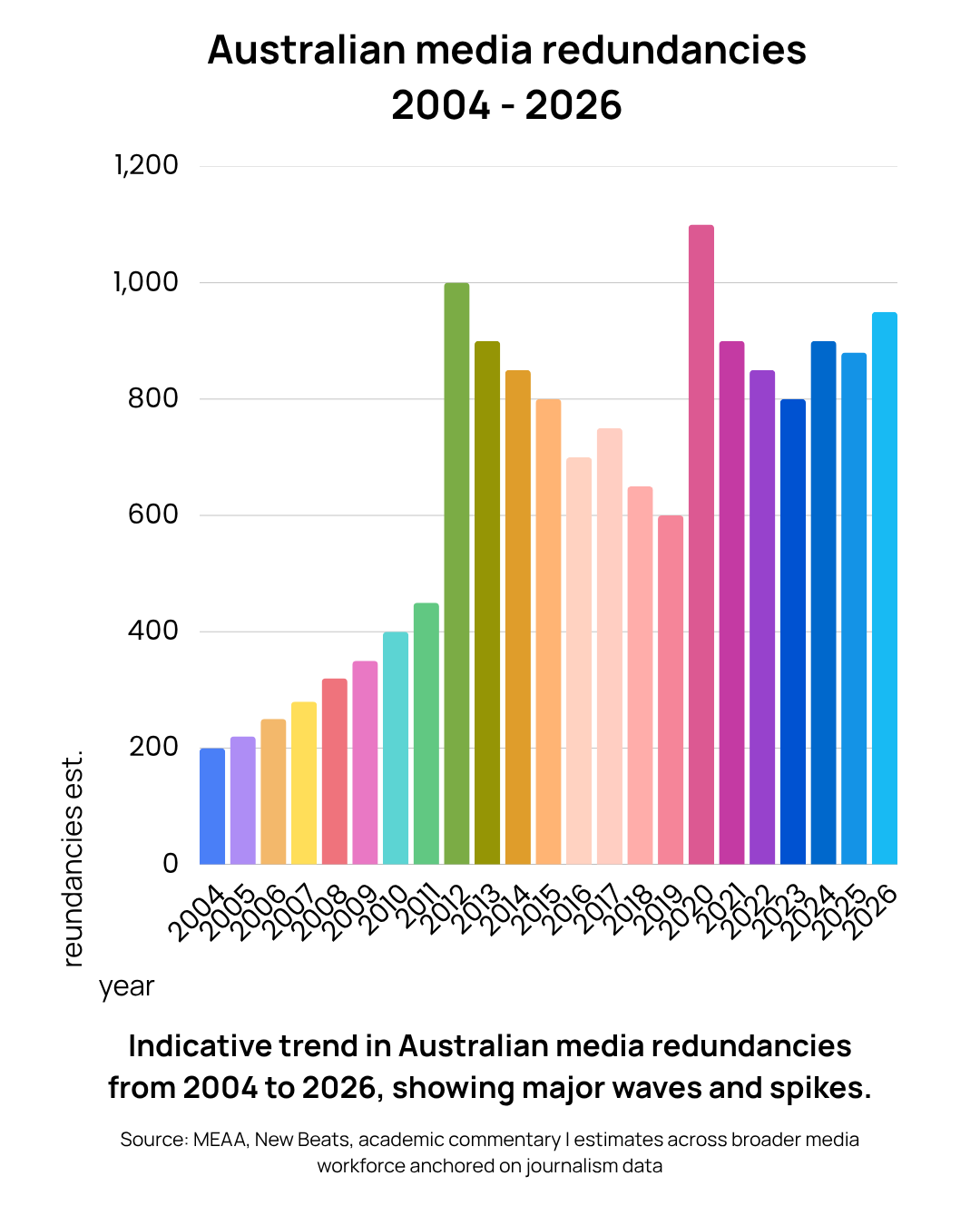
From the mid 2000s onwards, redundancies in Australian media shift from occasional to structural. Research from the New Beats project estimates the journalistic workforce shrank by about 15 percent in 2012 alone, with roughly 1,000 journalists made redundant in that year. Over the past decade, the Media Entertainment and Arts Alliance estimates up to 5,000 journalists have left the industry, many through repeated waves of cuts.
Those early cuts never really stopped. They carried through COVID and into the latest rounds at Southern Cross and Seven West, Nine, News Corp and others. Southern Cross and Seven West plan to eliminate between 250 and 300 full time roles by June 2026, citing weaker TV advertising and targeting 145 to 150 million dollars in annual savings on forecast revenue of around 1.86 to 1.87 billion. In 2024, Nine announced up to 200 redundancies, almost half in publishing at the Sydney Morning Herald, The Age and AFR, plus cuts in TV news and digital.
What looks like a sudden crisis in 2024 and 2026 is really a continuation of a pattern that began with the first big digital shake out.
Advertising Money Did Not Vanish, It Shifted
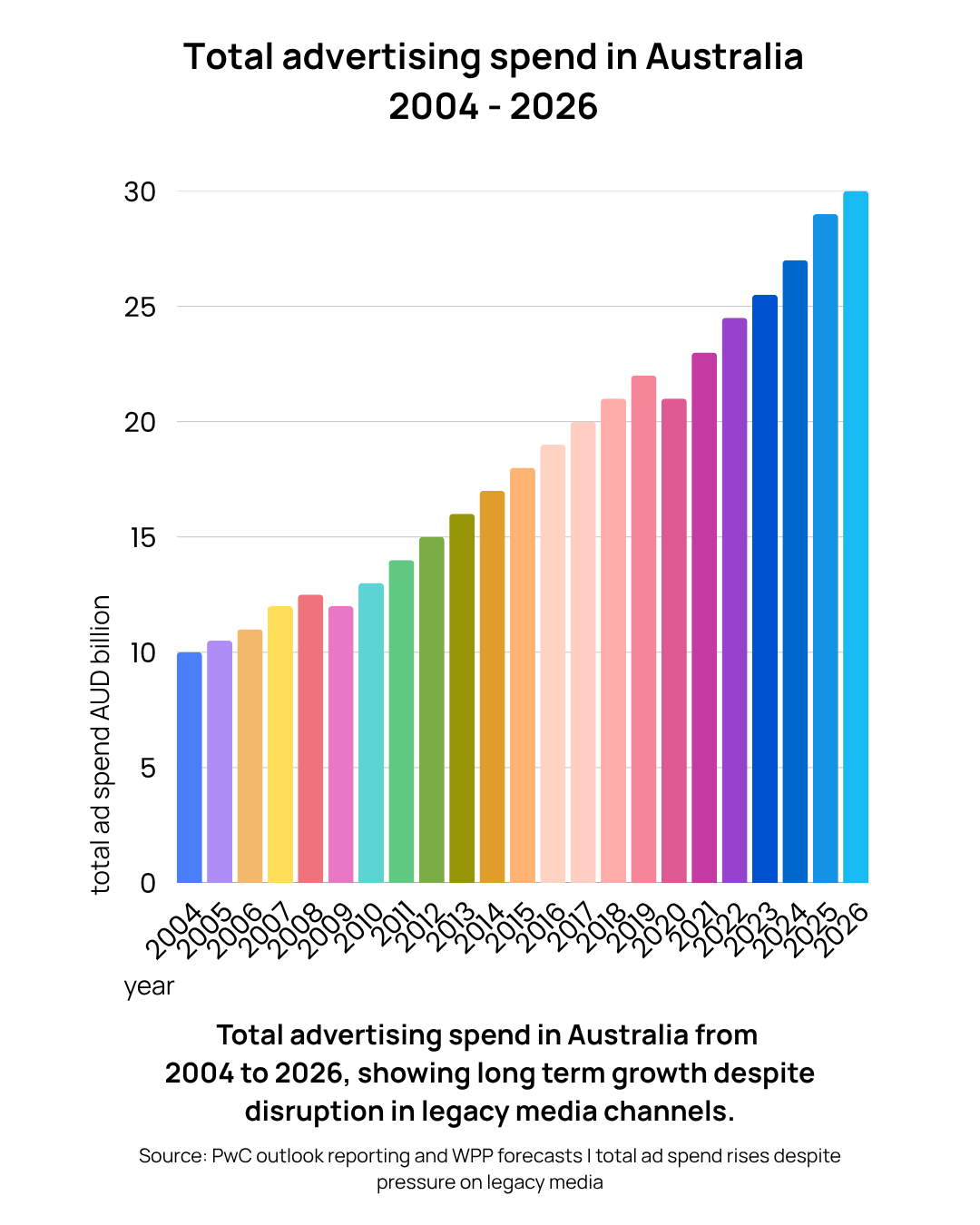
At the same time, the total advertising market in Australia has continued to grow.
Total entertainment and media revenue rose from about 60.6 billion dollars in 2022 to 62.3 billion in 2023. Internet advertising reached around 18.4 billion in 2025, up 11.5 percent year on year, with video around 5.4 billion and search more than 8.0 billion. Forecasts suggest overall ad spend could reach roughly 31.1 billion in 2026.
So the problem is not that the money disappeared. It is that budget has moved away from the channels that used to fund big newsrooms, studios and production teams.
Television and traditional audio are under pressure. Forecasts from WPP and others suggest TV advertising revenue will fall to about 3.0 billion in 2026 and then to 2.8 billion in 2027, while audio declines to about 1.2 billion in 2026 with further contraction in 2027. As agency rates fall and buyers push for discounts, media owners cut content budgets and talent costs. That creates a loop where cheaper content struggles to command premium prices, which leads to more cuts, which leads to weaker products again.
I saw this producing Abbie Chatfield’s podcast. We were a tiny team, but the show was commercially healthier than big radio formats with entire floors of staff behind them. The money was still there. It had shifted into digital ecosystems and creator led formats that the traditional media business model was not built to integrate.
Audience Behaviour: Moving Away From Traditional News
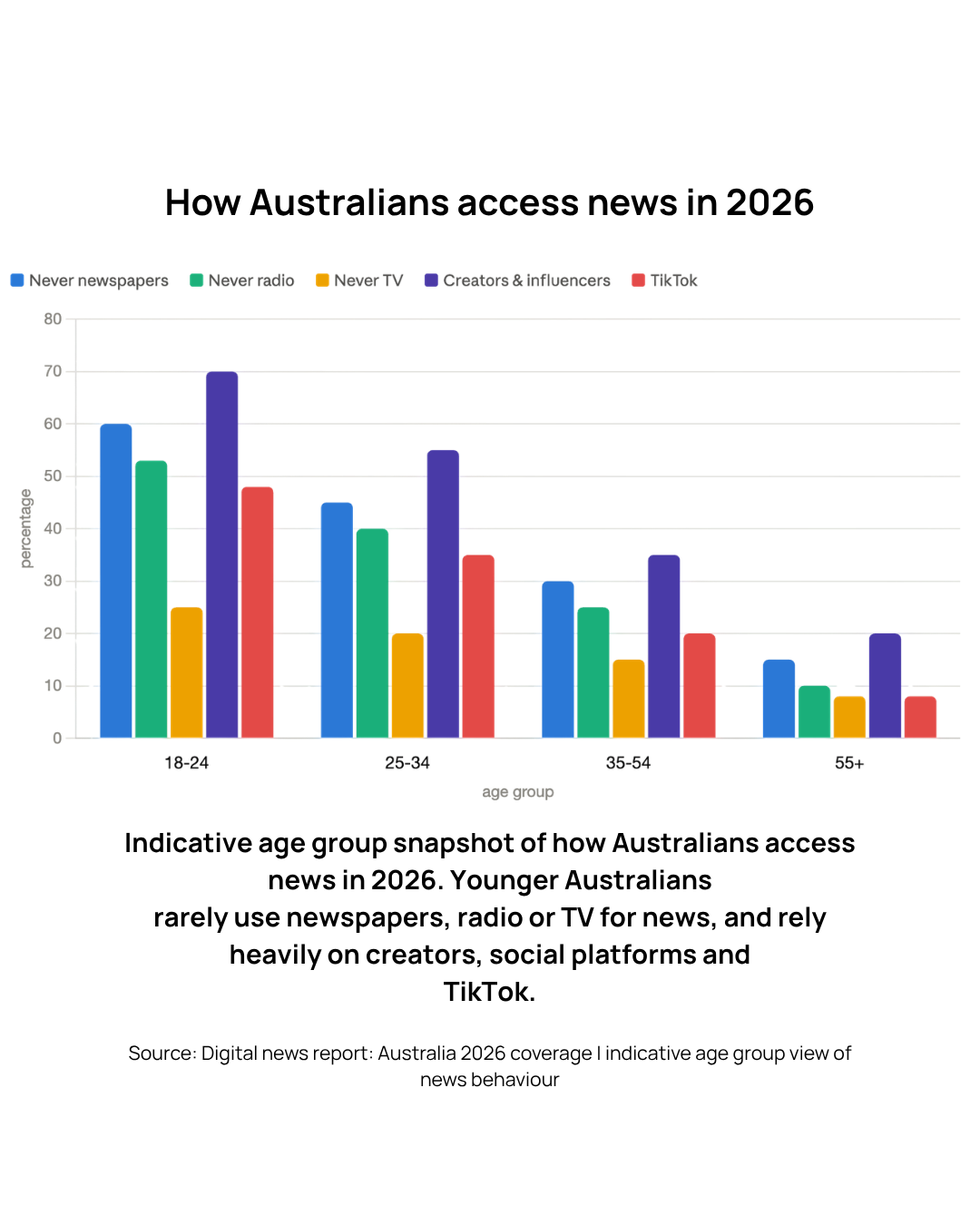
A lot of this is driven by audience behaviour rather than only corporate decisions.
The Digital News Report Australia 2026 shows younger Australians turning away from newspapers, radio and TV as sources of news. Among 18 to 24 year olds, around 60 percent have never used newspapers for news, 53 percent have never listened to radio news, and 25 percent have never watched TV news for information. Nearly half of that age group get news from TikTok and about 70 percent from creators or influencers.
Across the whole population, about 43 percent of Australians now get news from creators or influencers. Around 56 percent use social media for news, just behind TV and ahead of news websites and apps. Social media has overtaken direct visits to news websites as the main way Australians access online news.
So audiences still care deeply about information. They just do not care about traditional structures. They care through creators, social feeds, TikTok and increasingly AI tools.
I experienced this as the young person in the building saying “let’s bring video into podcasting” and “let’s shift the model and go digital” and mostly being ignored. Leadership listened too slowly. Instead of bending to where audiences actually are, many organisations chose to cut.
AI Is Fueling A New Wave Of Job Cuts
Recent redundancies also track closely with AI adoption inside media businesses.
The 2026 Medianet Australian Media Landscape Report notes that 22 percent of journalists say they or someone they know lost work in the previous year due to AI, and 93 percent are worried about its long term impact on journalism. AI tools that scrape local news, compile bulletins and generate copy reduce the perceived need for entry level and production roles, even when companies insist humans still fact check and edit everything.
AI is not the only cause, but the timing matters. As AI use crosses a majority threshold inside newsrooms and media organisations, the response has often been to remove people rather than redeploy them into new, higher value roles.
Policy And The News Media Bargaining Code
Policy has also played a role.
The News Media Bargaining Code was designed to force platforms like Meta and Google to pay for news content, giving publishers a financial lifeline. Those deals initially helped fund newsrooms and regional coverage. Over time, several agreements expired or shrank. Meta walked away from renegotiations. Google reportedly cut the value of some deals by nearly half and shortened their terms.
As those arrangements weaken or disappear, we see fresh redundancy rounds at Nine, News Corp and Seven West. This happens at the same time as advertising money is moving and AI is rolling out, which intensifies the shock.
Mergers, Synergies And Human Costs
Mergers and acquisitions add another layer of instability.
Seven West Media’s combination with Southern Cross Austereo in early 2026 is one example. It promised synergies and efficiency. In practice, it meant a cost base reset that translated into hundreds of redundancies across TV, radio and publishing.
Each merger becomes a moment where staff are moved around like assets. For people inside these organisations, “synergies” mean months of anxiety followed by consultation processes and job losses.
It Is Not Just Media: The Broader Economic Story
All of this is happening inside a wider economic story in Australia.
Information industries have lost around 60,000 jobs over the past 15 years, almost half during COVID. Manufacturing has declined faster than most sectors, and tech and other white collar redundancies have been quietly rising. Journalists report growing financial pressure, with median salaries drifting down and cost of living stress now their top personal challenge.
The redundancy pattern in media is one example of how Australia is dealing with technological disruption, platform dominance and economic pressure across multiple industries, not a strange exception.
What Happens Next And How We Respond
On the right hand tail of the redundancy graph, from about 2021 onward, it is not only about loss. It is where new structures are emerging.
9.1 Independent And Creator Led Media
The same forces that drove redundancies are also pushing new structures to emerge.
Independent And Creator Led Media
When legacy media cannot or will not adapt, talent builds its own infrastructure.
I am already working with Antony Loewenstein and watching Ette Media, Deep Cut and Lamestream build independent, creator led media models. They are moving into newsletters, podcasts, vertical video and explainers, funded by subscriptions, sponsorships and a mix of freelance work.newbeatsblog+4
The jobs that disappear from big payrolls do not all vanish. Some of them reappear as micro media businesses and creator journalist roles. It is not easy or secure, but it is a natural response to the shifts in money and audience.
Creator Literate Media Organisations
We also need organisations that understand this reality from the ground up.
Cheek Media is one example. Small, nimble, values driven, digital native and audience first. Future oriented media organisations look more like this. They are built around social, newsletters, podcasts and video as default. Their business models mix memberships, brand partnerships and philanthropy. They form long term partnerships between creators and newsrooms, where creators co report and co host serious topics, not just do surface level content.
That is where I see opportunity. Use the story of redundancies, the shift in advertising spend, and the data on audience behaviour to argue for creator literate media as the new normal.
Policy And Funding Settings
Finally, if we want fewer mass redundancies and more sustainable careers, we need policy and funding settings that match the current reality.
Ideas already being discussed include tax offsets or credits for independent digital publishers who invest in public interest content. Public and philanthropic funding for community journalism and creator journalists in regions where legacy outlets have pulled back. Regulation that recognises independent digital media and creator led news as part of the public interest media ecosystem, not only as marketing.sarahhenderson+6
Until we see those kinds of changes, the same three forces will keep working against each other. Jobs will be cut, money will chase attention, and audiences will keep drifting further away from structures that once felt permanent.
Resources
Medianet – 2026 Australian Media Landscape Report.
New Beats – Mass redundancies and career change in Australian journalism.
MEAA – The future of work in journalism and estimates of journalism job losses.
IAB Australia – Internet Advertising Revenue Report (internet ad spend and video growth).
Digital News Report: Australia 2026 – News and creator consumption trends, AI and disengagement.
Southern Cross / Seven West redundancies and merger coverage.
News Media Bargaining Code deal expiries and platform behaviour.
Cheek Media Co – Independent progressive commentary and audience reach.
Media‑Diversity.org – Independent journalism and the creator economy.