
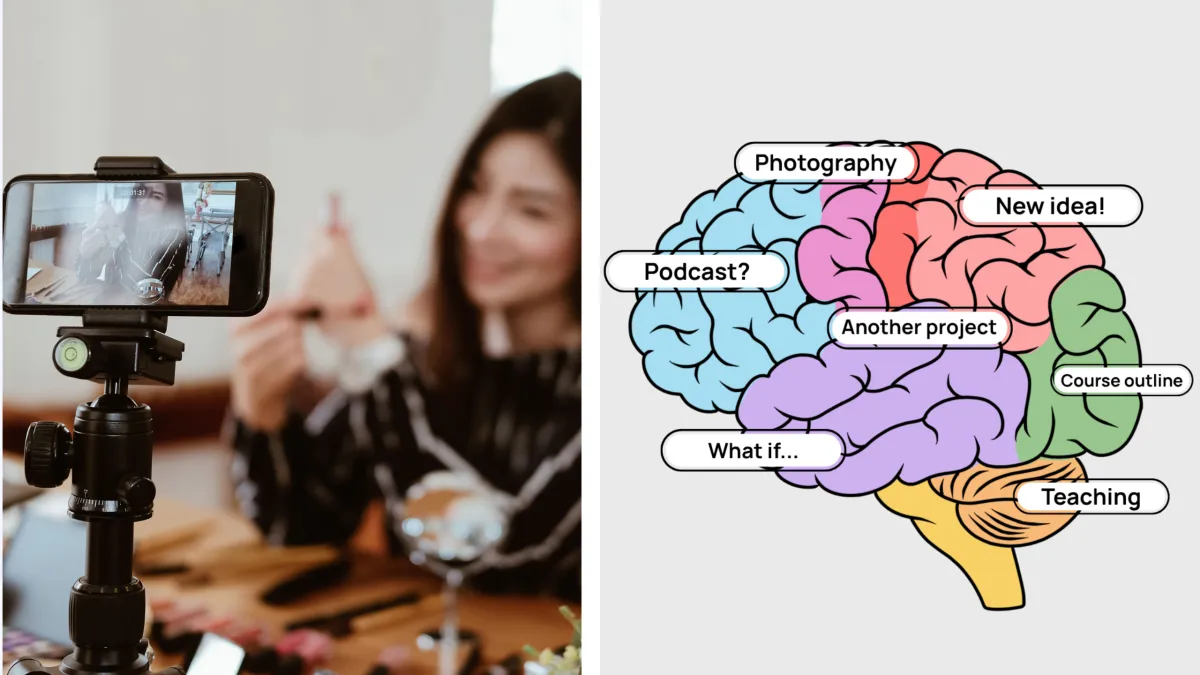
ADHD Brains in a Neurotypical Internet: Why Social Platforms Don’t Fit Us
"I do photography. I have great cameras. I teach as well. Oh, and I just submitted a screenplay. Hoping I'll hear back soon."
For many ADHD minds, that's just an ordinary rundown of a day; several skills in motion, several identities coexisting, ideas that all feel alive at once. The confusion rarely comes from inside the brain. It shows up outside it, in how the digital world tries to flatten that range into something a feed can categorise.
I spend a lot of time with ADHD professionals trying to build a presence online. They arrive with portfolios, passions, half-finished "about" pages, notes for courses, drafts of scripts. The same tension keeps surfacing. Internally, they see themselves as layered. Externally, they're told to pick one lane. Most personal branding advice isn't written with neurodivergent minds in view. The advice is written for an internet that assumes a neurotypical way of paying attention.
The outcome is a chronic mismatch. ADHD creators do what their brains do best: move between interests, follow curiosity, make unexpected connections. Platforms do what their systems do best: reward sameness, clarity, repetition. That friction isn't just an annoyance. It shapes who gets seen, who feels like they belong online, and whose stories get treated as coherent enough to spread.
Why the internet feels built for neurotypical attention
Major platforms didn't set out to exclude neurodivergent people. But their recommendation engines were trained on patterns of engagement that are relatively stable, and their feed and notification design assumes people interact with content in predictable, bounded ways. Those baselines line up far more neatly with neurotypical attention than with ADHD.
From the outside, the rules look simple: post consistently, stay on topic, keep a clear identity, keep your audience's expectations steady. Underneath those rules sits a deeper assumption about cognition; that attention travels in straight lines over long stretches, and that people can hold one narrow narrative about themselves without needing to expand or revise it constantly.
Because of that, platforms tend to reward creators who present a single, easily labelled version of themselves: the "ADHD coach," the "wedding photographer," the "productivity guru." Once a label sticks, the system knows who to show the work to and what to expect next. Plenty of ADHD professionals don't experience themselves in those singular terms at all. Their sense of self feels closer to a constellation than a logo.
That gap has real consequences. Digital presence is tied to income, opportunity, community, even basic visibility and so building systems around one narrow model of attention isn't a neutral design choice. It decides whose path is smooth, whose feed makes immediate sense to a stranger, and whose work sits slightly out of step with the format no matter how good it is.
What platform logic does to ADHD attention
ADHD attention rarely travels a straight line for long. It jumps, loops, dives, resurfaces. Novelty grabs it, and new ideas tend to arrive faster than old ones get finished. In work that benefits from cross-pollination between disciplines, that pattern is often a genuine advantage; a source of insight other approaches miss.
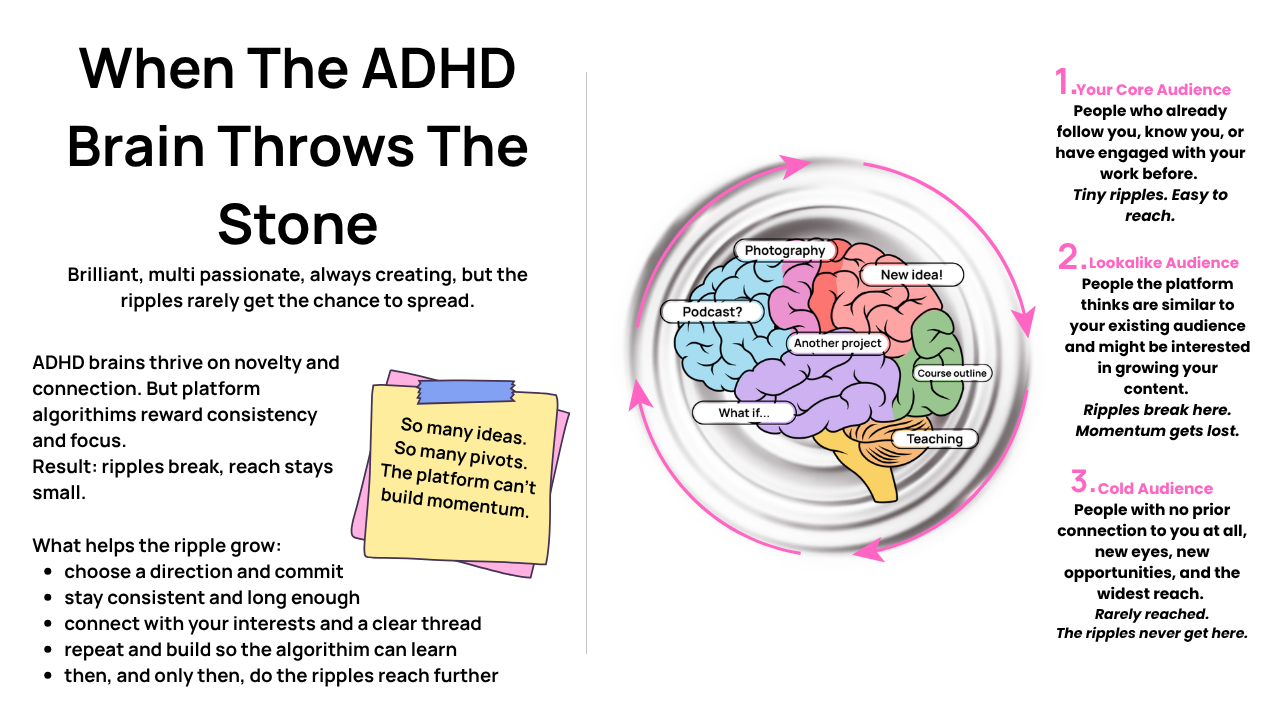
Platform logic prefers a slower, flatter rhythm. Consistency reads as reliability. Repetition reads as proof you know what you're doing. Keep producing the same kind of content, and the system can safely recommend it to similar people and predict how they'll respond. Change too often, and the recommendation engine has to start over and retest the audience, hunt for new viewers, work out what you "are" now.
Picture a stone thrown into a pond. The first ripple is small: people who already follow you, know you, or have engaged with your work before. The platform tests new content on them and watches quietly. If they watch, comment, save, or share, the system flags that content as promising, and a wider ripple appears; people who resemble your existing audience. Hold the pattern, and the ripples keep spreading outward toward people with no prior connection to you at all.
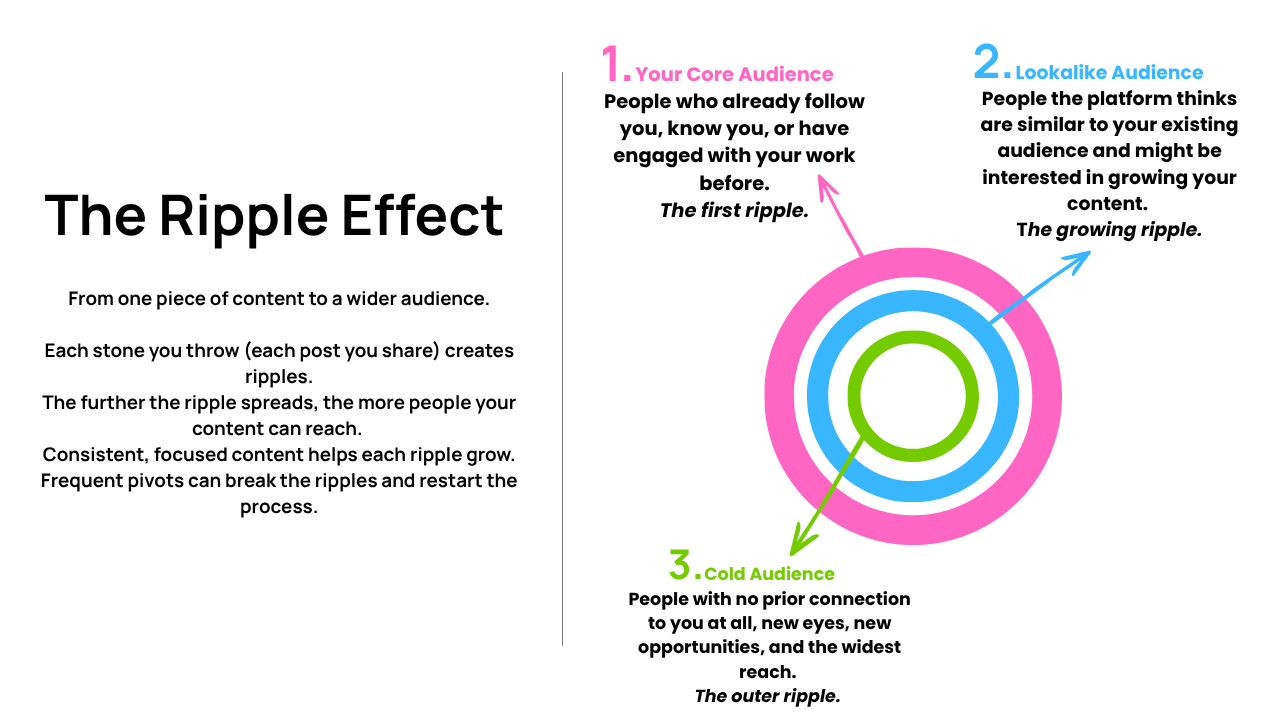
From the platform's side, this process is safest when every stone is roughly the same shape. A steady stream of similar content makes each test easy to read. From an ADHD point of view, that same stability is exactly what triggers boredom because once an idea starts working, it often loses its charge, and the brain behind it is already reaching for something new.
Follow that pull and pivot quickly, and the system doesn't register an engaged mind exploring. It registers interruption. The ripples break, and the learning process resets. Over time, that loop can leave ADHD creators feeling permanently stuck at the smallest ripple, never quite reaching the wider audience their work deserves.
Why multi-passionate identities struggle to translate online
Offline, people can hold complexity. Friends, colleagues, and long-term collaborators know you're a photographer and a teacher and a writer, and understand why your focus shifts and how the pieces connect because they have years of context.
The internet rarely offers that patience. A stranger lands on a profile and forms a judgement within seconds: a handful of posts, a skimmed bio, a glance at the grid. If that snapshot holds too many elements without an obvious thread, it reads as incoherent. The visitor doesn't see the range you’re offering. They only see noise.
For ADHD creators, whose identities are often genuinely plural, that's a harsh translation. It forces a choice between authenticity and legibility: Show the full spread of what you do and risk confusing new visitors, or trim your public self down to something digestible and watch pieces of it disappear from view.
There's a third option, though it takes intention: sequencing rather than shrinking. Decide the order in which the internet meets each part of you. Photography might be the first layer people encounter; the one that builds initial trust and recognition. Once that relationship exists, teaching can appear as a natural extension of what you already do. Writing, or whatever comes next, can step into view later, framed as an evolution rather than an unrelated side quest.
This doesn't make platforms neurodivergent-friendly on its own. It still asks you to speak the language of clarity better than the system speaks the language of complexity. But it hands back some control over the translation, and it cuts down the sense that parts of you have to be amputated just to be understood.
Algorithms, attention, and the "misfit" problem
Discussions of ADHD and technology tend to centre on deficit and risk; distraction, impulsivity, vulnerability to addictive design. Those concerns are real, but they're only half the picture. There's a growing body of thought on how digital environments both align with and exploit ADHD attention, and on how algorithmic systems misread neurodivergent behaviour more broadly.
Recommendation engines optimise for signals like time spent, clicks, and interactions; signals that don't distinguish between attention that zigzags because of ADHD and attention that follows a more conventional pattern. Bursty consumption, frequent topic-switching, intense engagement with emotionally charged material: the system treats all of it as just more data to optimise around, not as a distinct cognitive style.
The same happens on the creator side. A feed with sudden shifts in tone, topic, and format can register to an algorithm as low coherence or low reliability, even when those shifts are a natural expression of a neurodivergent mind moving through its interests. Some researchers now describe this as algorithmic misfit: people whose way of attending and expressing themselves doesn't sit comfortably inside the assumptions built into platform design.
That misfit reaches beyond visibility. It shapes how at-home neurodivergent users feel in online spaces, how likely their work is to reach people who'd value it, and how moderation and safety systems interpret their behaviour. It's part of why the internet can feel perfectly suited to ADHD; endless novelty, and exhausting at the same time, because of how rigid its expectations turn out to be.
Building a brand without betraying your brain
Standard personal-branding advice which is “pick one niche, show up daily in the same way, stick to your content pillars” is written for people whose relationship with focus already matches what the platform expects. To an ADHD professional, it can sound like instructions to become someone else.
A few working principles help:
Treat consistency as something you design, not a moral test you keep failing. Instead of forcing yourself to care about one topic forever, build a small set of formats and rhythms sturdy enough to survive your changing moods; a weekly teaching thread, a recurring behind-the-scenes vignette, a set of visual templates. The format stays; your fascination is free to move underneath it.
Use external signals to counter internal boredom. When your brain is done with a subject, it's tempting to assume everyone else is too. Watching what people actually save, share, or ask you about is a better gauge of a piece's usefulness than how exciting it currently feels to make.
Plan the change instead of letting it ambush you. Think in seasons. Like a stretch of time focused on one part of your work, long enough for people and platforms to understand it, with a deliberate shift built in afterward. The pivot becomes part of the narrative rather than evidence of chaos.
The underlying point: a brand doesn't have to match neurotypical norms to succeed. Brands that contain contradiction, that grow like organisms rather than products, have real value even when the internet doesn't immediately know what to do with them.
Making space in systems not built for us
Platforms aren't going anywhere, and neither is the pressure to perform a single, legible identity within them. For ADHD and other neurodivergent minds, the real question isn't whether to opt out. It's how to inhabit these systems without losing the shape of who you actually are.
Some of that work is structural: pushing for design that takes different attention patterns seriously, naming algorithmic bias when it harms neurodivergent users, backing research and advocacy that push for more inclusive frameworks. Some of it is personal: noticing when you're bending out of shape just to be legible, and finding ways to tell your story that stay true to how your mind actually works.
Somewhere, a version of the internet exists where platforms expect tangents, reward sudden shifts, and make room for multi-passionate identity as a matter of course. Maybe pieces of that will show up eventually. Until then, the task isn't to prove ADHD minds can behave like everyone else. The task is to insist that this way of thinking, making, and connecting has value even when it doesn't fit the template.
FAQ
Why don't social media algorithms work well for ADHD creators?
Recommendation engines are trained on stable, predictable engagement patterns. ADHD attention shifts between topics and formats, which the algorithm reads as inconsistency rather than exploration thereby resetting the "learning" process each time a creator pivots.
What is "algorithmic misfit"?
A term describing people whose attention and expression style doesn't match the assumptions built into platform design, leading to lower recommendation reach even when the content itself has value.
How can multi-passionate creators present themselves online without confusing their audience?
By sequencing rather than hiding parts of their identity, introducing one skill or interest first to build trust, then letting others appear later as natural extensions rather than presenting everything at once.
Does ADHD mean you can't build a consistent personal brand?
No. Consistency can live in a format or rhythm (a recurring content type, a visual template) rather than in a fixed topic, e.g letting the underlying interest shift while the container stays recognisable.
Further reading
ADHD as neuro-divergence in the digital world
An editorial in the Journal of Child Psychology and Psychiatry that argues ADHD should be understood in digital context, noting that online environments can both align with ADHD attention and create distinctive risks.Artificial intelligence for neurodiversity
A BMJ piece on how algorithmic bias can disadvantage people with neurodevelopmental conditions, including ADHD, because AI systems are often built around “average” users rather than cognitively diverse ones.Characterizing Collective Efforts in Content Sharing and Quality Control for ADHD-relevant Content on Video-sharing Platforms
A 2025 study of TikTok and YouTube ADHD content that explores creator types, presentation styles, accessibility issues, and the ways viewers and creators collectively shape content quality.