
"Everyone Has ADHD Now"? No. We're Just Finally Seeing What Was There
A 14-Year Journey From Pathology to Neurodiversity And Why Rising Diagnoses Reflect Visibility, Not Proliferation
"Everyone has ADHD now." "They're multiplying." "We're over-diagnosing people."
No. We're just finally seeing what was always there.
Back in 2012, when I graduated from university with a degree in Psychology, things felt much more black and white when it came to autism and ADHD.
They were disorders. You looked them up, got diagnosed, and in the case of ADHD, maybe got medication to help manage the symptoms. But realistically, whether you "had" autism or ADHD, the message was often the same: this is something you'll live with forever.
I felt sad for those people.
I was taught to view autism through a lens of social isolation and ADHD through a lens of impairment. At the same time, I was fascinated by both. I'd been interested in autism since I was 16, when I wrote my IGCSE research paper about an autistic five-year-old I knew.
What struck me was that there didn't seem to be anything inherently wrong with him.
But because I was approaching it through a pathological lens, "wrong" was exactly what I was searching for.
Fast forward 14 years, and the landscape has changed dramatically; backed by new evolutionary research showing these traits may have been advantages all along.
The Neurodiversity Framework Takes Hold
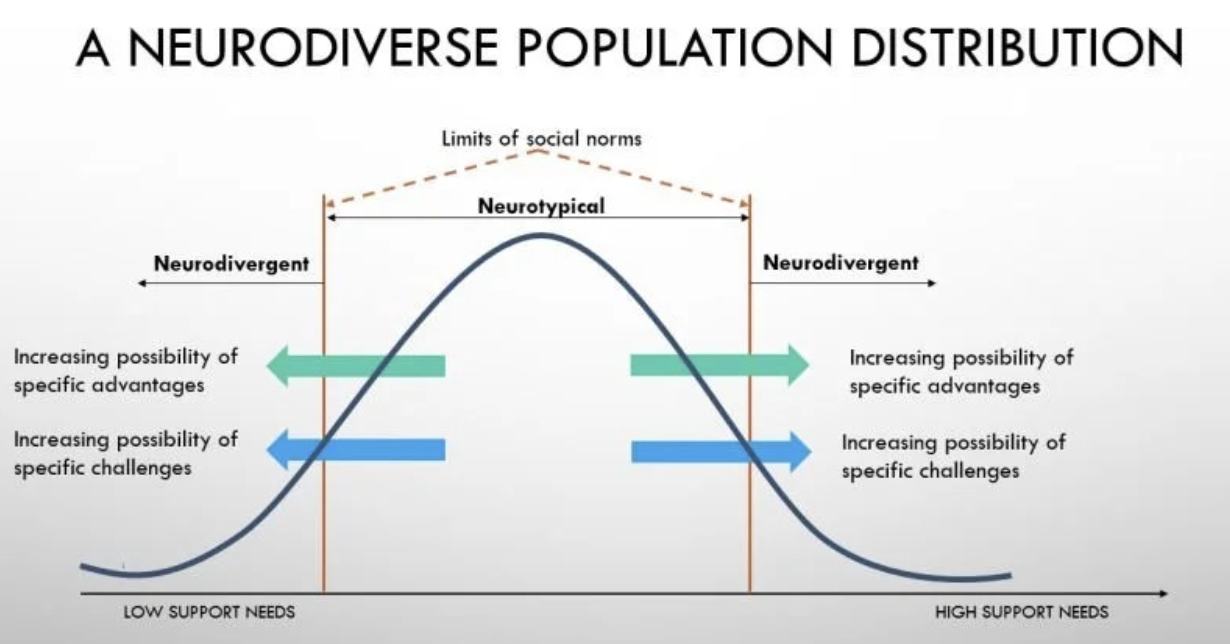
Autism and ADHD are still recognised as clinical diagnoses, but they're increasingly understood through the framework of neurodiversity: the idea that brains naturally vary, and that not every difference is a deficit.
We all exist across a spectrum of traits. Some people sit close to the middle of the bell curve. Others diverge from it more significantly. The difference itself isn't necessarily the problem.
When Does Difference Become Disorder?
In psychology, a condition is generally considered disordered when it involves some combination of:
Significant personal distress
Harm to oneself or others
Difficulty functioning in daily life
Behaviour that seriously violates social or cultural expectations
The key point is that difference alone isn't enough.
An autistic person isn't automatically disordered because they're autistic. An ADHD person isn't automatically disordered because they have ADHD. What matters is whether those traits are creating meaningful impairment or distress.
The original purpose of diagnostic frameworks was to help us identify patterns, understand people better, and provide support. The downside is that over time, those frameworks often become attached to stigma.
For centuries, we've become accustomed to viewing these ways of being primarily through what they lack rather than what they contribute.
Evolutionary Psychology: Autism and ADHD Traits as Ancient Adaptations
More recent research is pushing us to think differently. Some evolutionary psychologists have proposed that traits associated with autism and ADHD may have provided advantages in different environments.
ADHD Traits: The Hunter-Gatherer Superpower
In hunter-gatherer societies, traits associated with ADHD likely offered considerable adaptive advantages:
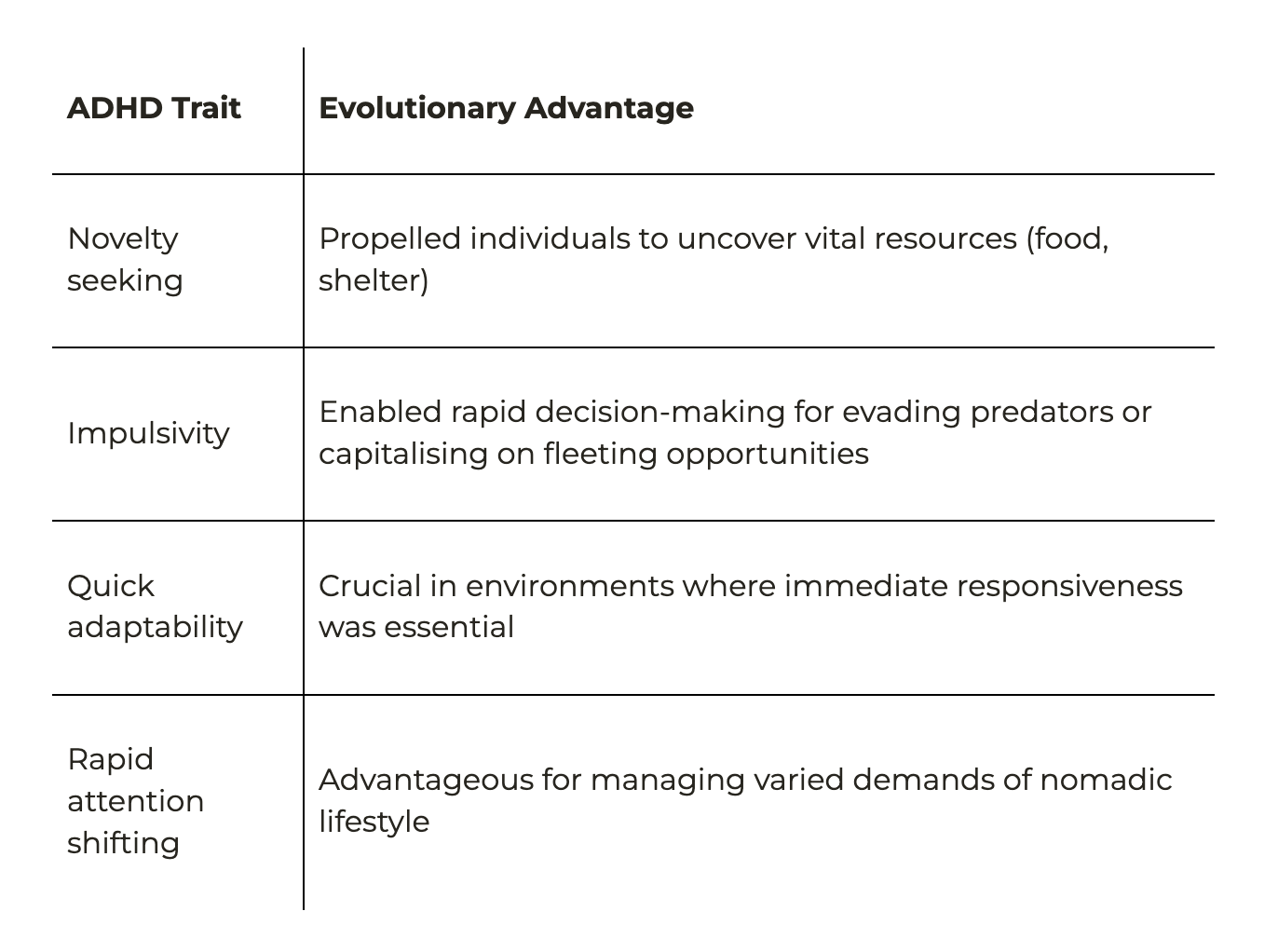
A 2025 study published in Proceedings of the Royal Society B tested this with an online foraging game. Participants with higher ADHD trait scores:
Spent less time in each berry patch
Moved on quickly to search for better spots
Collectively gathered more berries overall
Dr. David Barack (University of Pennsylvania) explained: "If [these traits] were truly negative, then you would think that over evolutionary time, they would be selected against." Instead, they persisted, possibly because they once offered significant advantages.
Genetic evidence: ADHD markers are more common in populations with nomadic histories, where exploration, risk-taking, and fast responses were essential for tracking migrating herds, avoiding predators, and finding water sources.
Autism Traits: Precision, Pattern Recognition, and Systematising
Researchers like Simon Baron-Cohen, Bernard Crespi, and Marco Del Giudice propose that autistic traits can be understood not as deficits, but as adaptive intelligences that evolved for specific functions:
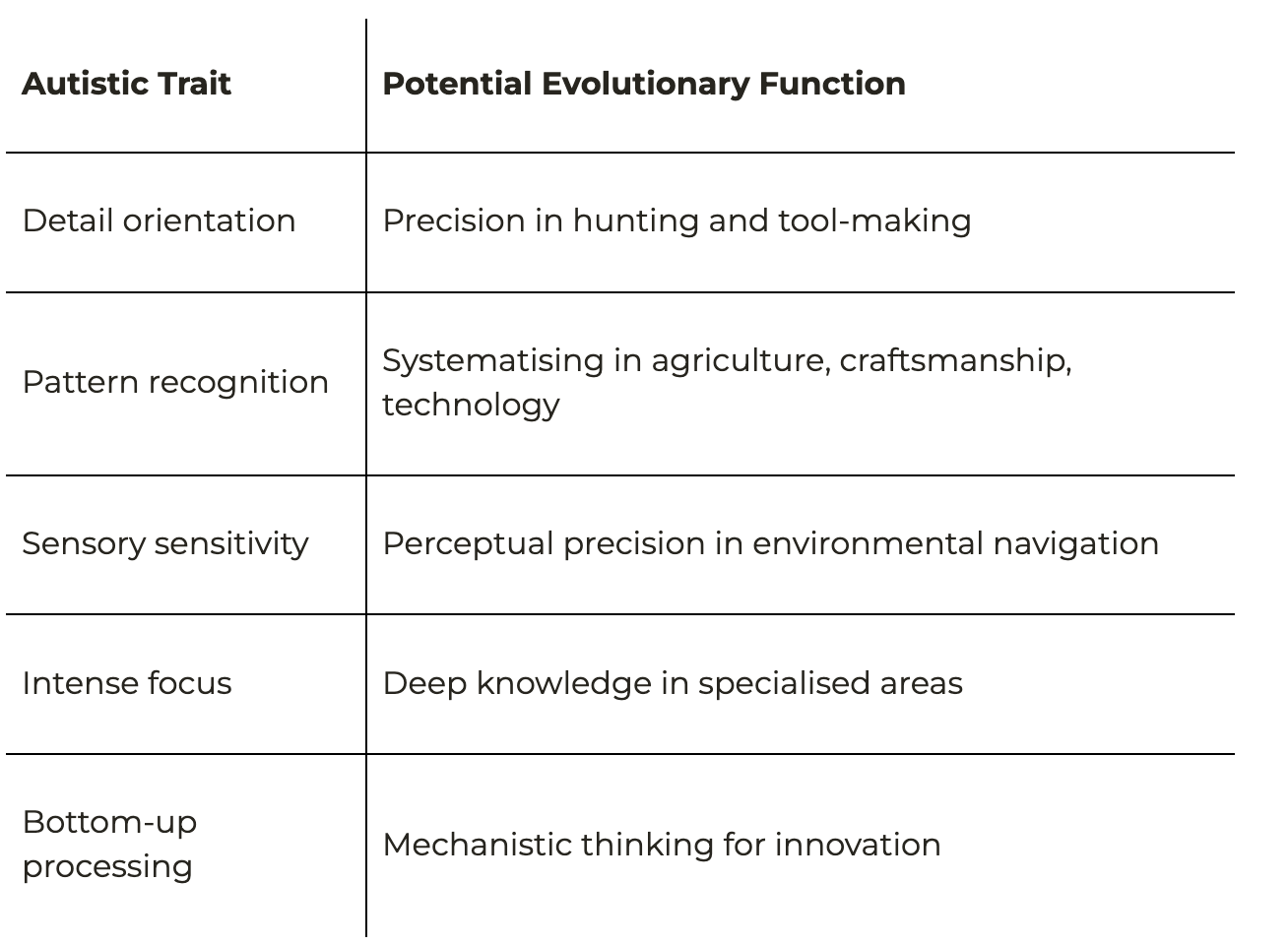
These traits are disproportionately represented in fields like science, engineering, and information technology; niches that historically favoured precision and innovation.
A 2025 Stanford study found that genes associated with autism evolved rapidly alongside human intelligence, suggesting neurodiversity may be an essential consequence of human evolution.
The Evolution-Mismatch Problem
So why do these traits cause problems today?
The answer lies in the misalignment between ancient brains and modern environments:
Classrooms require sitting still for hours
Workplaces reward sustained attention and meticulous planning
Technology floods us with distractions while demanding self-regulation
Professor Michael J. Reiss (UCL) summed it up: "ADHD can be a serious problem, but it's a problem in large measure because of today's environments."
What helped our ancestors succeed can now lead to frustration in rigid systems.
"Everyone Has ADHD Now"? No. We're Just Finally Seeing What Was Always There
While these evolutionary theories are still being debated, they challenge a simple assumption: that neurological differences exist only as deficits. They may also represent adaptations that were useful in different contexts.
Yet when people hear about rising diagnosis rates, a common reaction is:
"Everyone has ADHD now."
"They're multiplying."
"We're over-diagnosing people."
We've seen this pattern before. Whenever a previously misunderstood group becomes more visible, some people assume the group itself is growing. We saw it with conversations around sexuality. We've seen it with race and identity. Visibility is often mistaken for proliferation.
The ABC's Four Corners recently explored concerns around the rise in ADHD diagnoses and stimulant prescriptions. And I'm not denying there are practitioners who may not be following best-practice diagnostic protocols.
But there are also other explanations for why we're seeing more diagnoses:
1. Historical Focus on Boys and Men
ADHD and autism research overwhelmingly studied males. We're only now beginning to understand how these traits present in women, which means many women are finally recognising themselves in descriptions that never previously fit.
2. Modern Environments Make Traits Harder to Manage
Schools, workplaces, technology, and social expectations weren't designed with neurodivergent people in mind.
3. People Now Have Language for Lifelong Experiences
When people finally hear someone describe their inner world accurately, it resonates.
My Story: Getting Diagnosed and Untangling Years of Pathological Thinking
Then there's me.
Getting diagnosed with ADHD was a whirlwind.

I had to untangle years of thinking about ADHD through a purely pathological lens and start understanding it as a way my brain works rather than a list of deficits.
I always knew I connected naturally with autistic and ADHD people. I found conversations easier. Communication felt more intuitive. I understood things that others seemed to miss.
What I didn't realise was that part of the reason for that was because I belonged to that community too.
From Diagnosis to Community: The Neurodivergent Shift
And increasingly, that's how many people are choosing to view autism and ADHD: not simply as diagnoses, but as communities.
Communities built around:
Shared experiences
Shared challenges
Finally feeling understood
People are feeling seen. They're feeling heard.
If finding that sense of belonging helps them recover from years of being pathologised, misunderstood, or forced to mask who they are, then I struggle to see that as a problem.
Why This Matters for Marketing Strategy and Talent Management
At my company; a marketing strategy and talent management firm with a focus on neurodivergence, we've seen firsthand how organisations benefit when they:
Recognise neurodivergent traits as strengths rather than deficits
Design environments that match how neurodivergent brains naturally work
Tap into diverse cognitive styles for innovation, creativity, and problem-solving
ADHD traits like rapid decision-making and energy fuel success in emergency response, entrepreneurship, performing arts, and innovation. Autistic traits like pattern recognition and deep focus excel in science, engineering, and technology.
The question isn't "What's wrong with this person?" but "What environment were they made for and how can we support them now?"
Resources
Evolutionary Psychology & ADHD
Columbia University Department of Psychiatry
– "Evolution and ADHD" (2024)https://www.columbiapsychiatry.org/research/research-areas/child-and-adolescent-psychiatry/sultan-lab-mental-health-informatics/
Global ADHD Network
– "Was ADHD an Evolutionary Advantage?" (August 2025)https://www.globaladhdnetwork.com/post/was-adhd-an-evolutionary-advantage
Barack, D. et al. – "Adaptive foraging in individuals with ADHD-like traits," Proceedings of the Royal Society B: Biological Sciences (2025)
Evolutionary Psychology & Autism
Psychology Today
– "Autistic Intelligences as Evolutionary Adaptations" (May 2025)https://www.psychologytoday.com/au/blog/atypical-children-extraordinary-parenting/202505/autistic-intelligences-as-evolutionaril
Stanford University
– "Neurodiversity could be an essential consequence of human evolution" (December 2025)https://humsci.stanford.edu/feature/neurodiversity-could-be-essential-consequence-human-evolution
Baron-Cohen, S., Crespi, B., Del Giudice, M. – Researchers proposing autistic traits as adaptive intelligences
Neurodiversity Framework
CliniKids
– "Neurodiversity: What is it?" (November 2023)https://clinikids.thekids.org.au/information-hub/blog/neurodiversity-what-is-it/
Northwestern Medicine
– "Understanding Neurodiversity" (April 2024)https://www.nm.org/healthbeat/healthy-tips/Understanding-Neurodiversity
Australian Psychological Society
– "Now is the time to enhance your neurodiversity-affirming practice" (June 2025)https://psychology.org.au/insights/neurodiversity-affirming-care
Environment-Mismatch Research
University College London – Professor Michael J. Reiss on ADHD and modern environments
ADHD TA
– "ADHD and Neurodiversity: Embracing Different Brains" (July 2025)https://adhdta.com.au/adhd-and-neurodiversity-embracing-different-brains/
This article is written for marketers, business leaders, talent managers, and neurodivergent individuals seeking to understand the shift from pathology to acceptance. If you're building a neurodiversity-affirming workplace or marketing strategy, let's connect.