Why Protected Focus Is a Game-Changer
Last year, I went through one of the most fundamental shifts of my career: moving from Executive Podcast Producer to Business Founder.
For a while, I was doing both, and to be honest, it backfired on my sanity and my family. It was a necessary transitional phase so I could exit a full-time role in April and launch a business that could realistically support me. Financially, the shift was smoother than I expected.
Mentally and professionally, even at the level of identity, the cost was far higher than I anticipated.
That invisible cost caught me off guard.
Starting (again) and pushing through
When I arrived in Australia at the end of 2017, I had to rebuild my professional life from scratch. So I knew that any new beginning comes with discomfort, and that consistency is usually the only way through it.
When I launched Bedou as a talent management business, I was doing everything at once:
building systems (invoicing, contracts, project management)
securing and managing talent deals
learning how to work from home full-time for the first time in my life
Eventually, I reached the point where I could bring people in to help run the operation. That came with its own lessons:
don’t trust blindly; trial first
not everyone who looks good on paper is good in practice
pay more for roles that are sensitive, complex, and nuanced
Even with support in place, something still wasn’t working.
The quiet problem I didn’t name
Working from home exposed a problem I didn’t immediately recognise.
Kids walking in. Cats scratching at the door. Me deciding to empty the dishwasher mid-task.
On paper, the business was running. Deals were moving. Systems were improving. But internally, I was frustrated. Not because things weren’t working, but because ideas were piling up faster than I could execute them.
That’s when the identity shift really hit.
Going from employee to founder rewires your brain. I realised that what I used to call “gut instinct” was actually entrepreneurial judgment, and it worked. I was good at seeing opportunities and taking calculated risks.
The problem wasn’t ideas.
The problem was time.
Time: the real bottleneck
How do you:
respond to deals
do cold outreach
delegate properly
manage multiple income streams
…inside a standard eight-hour workday?
You don’t.
So yes, I was sometimes up until 2am answering emails. Yes, I went through cycles of burnout where one week I felt unstoppable, and the next I couldn’t get myself to my desk. Yes, I masked through entire days while quietly falling apart.
I knew, logically, that I was doing well. I also knew I couldn’t sustain it.
The shift that changed everything
I’ve been in and out of therapy for seven years. Last year, I decided to try something beyond talk therapy and began somatic work (a whole piece in itself).
One suggestion from my therapist changed everything: Read Deep Work by Cal Newport.
I did, and it was genuinely a game-changer.
Newport defines deep work as long, uninterrupted periods of cognitively demanding focus. The kind of work that creates real value. He contrasts this with shallow work: reactive admin, constant emails, and performative busyness.
His argument is simple and confronting:
Deep work is becoming rarer at the exact moment it’s becoming more valuable.
Over the Christmas break, I committed to testing it in the new year.
Then I paired it with another book that reshaped my thinking:Four Thousand Weeks by Oliver Burkeman. A reminder that time is radically finite, and that trying to “fit everything in” is a trap, not a solution.
Together, they forced a perspective shift.
What protected focus looks like in practice
For three days each week, I now protect three hours of uninterrupted focus.
Each session has a clear purpose:
Business Strategy & Development
Talent Strategy
Revenue & Outreach
No Slack. No email. No meetings.
The impact was immediate.
I could measure progress. I felt calmer. My motivation increased because my day had shape and intention.
More importantly, I built boundaries (and a culture) around focus, so others could do the same.
The privilege I hadn’t noticed
The realisation that hit hardest was this: Most workplaces don’t allow this.
So many people are stuck in environments where being “online” from 9–5 matters more than producing meaningful work. Micromanagement, constant Slack interruptions, and performative responsiveness are quietly killing focus and productivity at scale.
If you manage people, I can’t recommend this approach enough.
If you can protect focus time, and teach others to do the same, it will materially improve your business.
A small but meaningful symbol
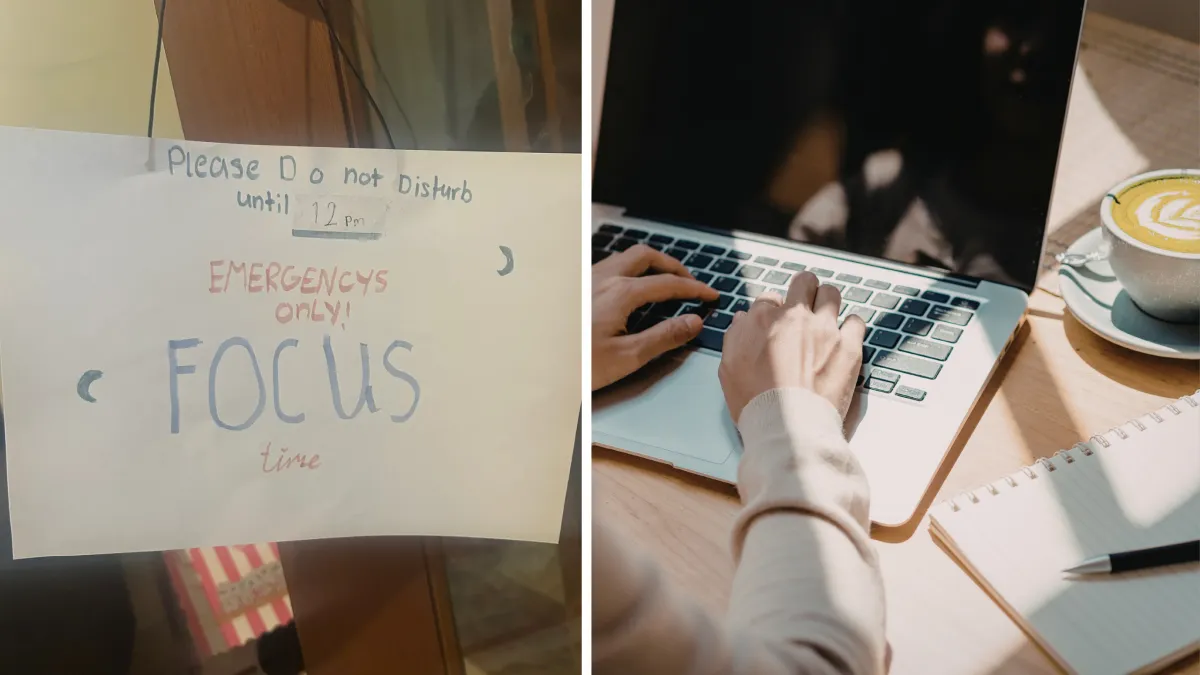
These days, I have a sign on my door during focus time. Handmade by my 11-year-old, reminding everyone not to interrupt.
It’s simple. It’s imperfect. And it represents something I had to learn the hard way:
Focus isn’t a luxury. It’s a leadership decision.